

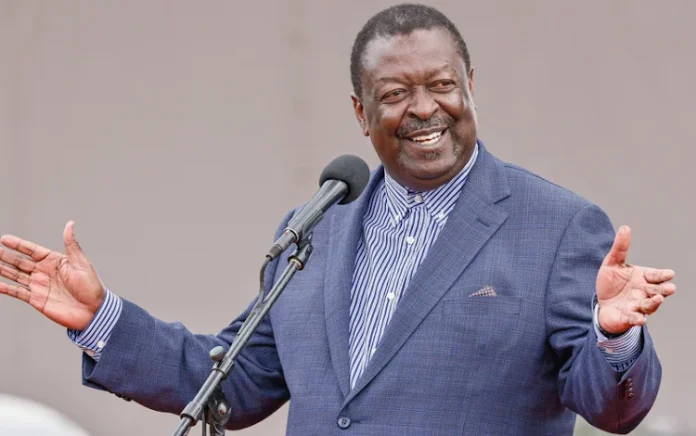


Prime Cabinet Secretary Musalia Mudavadi has outlined why Kenya must hold a referendum alongside the 2027 General Elections, warning that failure to address existing constitutional gaps could plunge the country into a major legal crisis.
Speaking during a press briefing, Mudavadi described the current period as a “constitutional moment,” saying urgent legal and structural reforms are needed to safeguard the credibility and legality of the next elections.
“Allow me to state without fear of contradiction that there is an imperative need for a constitutional review 15 years after the promulgation of the 2010 Katiba. As a country, we are staring at a massive legal crisis where the 2027 election could be nullified before it even begins,” Mudavadi said.
Boundary Review Crisis
Mudavadi explained that the Constitution requires the review of electoral boundaries every eight to 12 years, noting that the last deadline elapsed on March 6, 2024.
“We are now in a period of constitutional noncompliance. You cannot have a boundary review without a valid national census,” he said.
He pointed out that the 2019 national census was nullified in Mandera, Wajir and Garissa counties, adding that a mini-census for the affected regions is only expected to be conducted by January 2026.
Representation and Population Growth
The Prime Cabinet Secretary noted that Kenya’s population has grown significantly over the years, yet Article 89(4) of the Constitution caps the number of constituencies at 290.
“Without a constitutional amendment, the IEBC cannot give high-growth areas the representation they deserve, and our ‘protected’ constituencies face extinction,” Mudavadi warned.
He further highlighted legal contradictions at the county level, where the Constitution allows the Independent Electoral and Boundaries Commission (IEBC) to adjust County Assembly wards, but the County Governments Act restricts the number of wards to 1,450.
“This creates legal ambiguity and operational conflict that must be resolved,” he said.
Proposed Constitutional Reforms
Mudavadi said the proposed referendum would provide a platform to introduce critical reforms, including entrenching the National Government Constituencies Development Fund (NG-CDF) into the Constitution to protect bursaries and development projects.
He also proposed the creation of a Senate Oversight Fund and a Ward Development Fund to ensure grassroots projects such as water points and community halls receive funding without delays.
“For a unified face of Kenya in government, we must formalise the Office of the Prime Minister and the Leader of the Official Opposition to ensure every region sees its face in the mirror of government,” he said.
Additionally, Mudavadi noted that the referendum would offer an opportunity to fully implement the two-thirds gender rule, enhancing fairness and inclusivity in Kenya’s democratic process.
Legal Necessity, Not Politics
“No valid population, no boundaries review, and hence, no valid general election. Ignoring this is to act at grave peril to our constitutionalism,” Mudavadi cautioned.
He emphasised that holding a referendum in 2027 is not merely a political decision but a legal necessity aimed at harmonising laws, protecting electoral processes and ensuring constitutional compliance.
Mudavadi’s remarks have already sparked widespread debate across political and civic circles, setting the stage for what he described as a defining moment for Kenya’s democracy and governance ahead of the 2027 polls.