

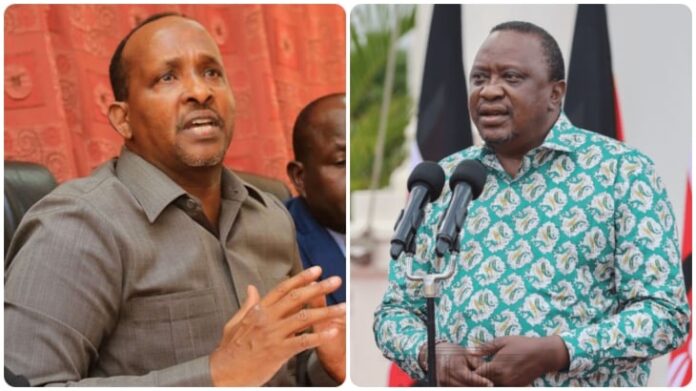


Former President Uhuru Kenyatta has once again found himself at the center of political debate after intensifying criticism of President William Ruto’s administration, sparking sharp reactions from leaders allied to the current government.
In recent weeks, Uhuru has openly faulted Ruto’s leadership style, accusing the administration of prioritizing political battles over pressing national concerns. Among the issues he highlighted is the country’s fuel situation, which he argues has placed a heavy burden on ordinary Kenyans while leaders remain distracted by political confrontations.
The remarks have drawn strong responses from senior government officials, including Health Cabinet Secretary Aden Duale, a vocal supporter of President Ruto.
Speaking during Eid-ul-Adha celebrations in Nairobi on Wednesday, May 27, Duale dismissed Uhuru’s criticism as politically motivated. He claimed the former president’s continued attacks on the Kenya Kwanza administration are aimed at undermining Ruto’s leadership rather than offering genuine guidance.
Duale urged Uhuru to follow the example set by previous retired presidents who stepped away from active political engagements after leaving office. According to the CS, former leaders such as Daniel arap Moi and Mwai Kibaki allowed succeeding administrations to govern without constant interference.
The Cabinet Secretary further alleged that Uhuru’s criticism of Ruto stems from long-standing political differences dating back to the period when Ruto served as deputy president in the previous administration.
He accused the former head of state of disguising personal grievances as constructive criticism, warning that persistent attacks on the current government risk fueling unnecessary political tension in the country.
The exchange reflects the growing political rivalry between the two leaders, whose relationship has significantly deteriorated since the 2022 General Election. As both camps continue trading accusations, the political atmosphere remains tense, with allies on either side increasingly taking public positions on national leadership and governance.