

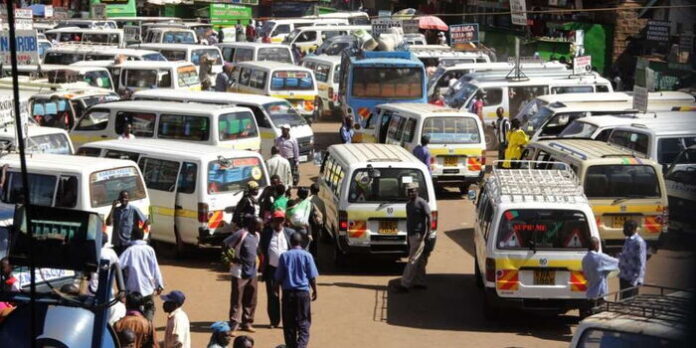


Kenyans who rely on public transport are bracing for significant disruption after matatu operators announced a nationwide strike set to begin on Monday, coupled with an immediate 50 per cent increase in fares, citing the government’s latest upward revision of fuel prices as the final breaking point for an already strained industry.
Industry at Breaking Point
The Matatu Owners Association, led by chairman Albert Karakacha, said the sector had been pushed to the edge by relentlessly rising operational costs and broken government promises, leaving operators with no choice but to take drastic action.
“On Monday, there will be strictly no movement of any vehicles; all the roads will be blocked until the government listens to our cry because we have been promised, but everything we are promised has not come to fulfilment,” Karakacha said in a strongly worded statement.
The association further directed all public transport investors and transport network companies across the country to immediately implement the 50 per cent fare adjustment, arguing it was the only viable way to sustain operations in the wake of the fuel price surge.
“All transport network companies, wherever they are, be aware that we are going to increase our prices by 50% because we don’t have the mechanism,” they warned.
What Triggered the Crisis
The announcement came just hours after the Energy and Petroleum Regulatory Authority (EPRA) released its latest monthly fuel pricing review, revealing sharp increases in the cost of key petroleum products.
Diesel — the primary fuel powering most public service vehicles — rose by a steep Sh46.29 per litre, while super petrol increased by Sh16.65 per litre. In Nairobi, petrol and diesel now retail at Sh214.25 and Sh242.92 per litre respectively. Kerosene prices were left unchanged for the review period covering May 15 to June 14, 2026.
EPRA attributed the adjustments to shifts in global oil markets and the rising cost of imported refined petroleum products, factors largely beyond Kenya’s immediate control.
Government’s Sh5 Billion Cushion Falls Short
Energy Cabinet Secretary Opiyo Wandayi had earlier defended the government’s position, revealing that approximately Sh5 billion from the Petroleum Development Levy (PDL) Fund had been deployed to cushion consumers against even steeper price increases.
“To mitigate the impact of rising global petroleum prices on consumers and the wider economy, the government has utilised the Petroleum Development Levy stabilisation mechanism to cushion the prices of Diesel and Kerosene during this review period,” Wandayi said.
He attributed the price pressures to a combination of rising crude oil prices, elevated freight costs, and ongoing geopolitical tensions in the Middle East. Despite the government’s intervention, the matatu industry argues the cushioning measures have not gone far enough to shield operators from the real cost of running vehicles on Kenyan roads.
Ripple Effects Across the Economy
The standoff arrives at a deeply sensitive moment for ordinary Kenyans. Fuel prices in Kenya have a cascading effect across the entire economy — influencing transport costs, electricity generation, food prices, and the broader cost of goods and services. A 50 per cent jump in matatu fares would hit millions of commuters who depend on public transport daily to get to work, school, and business.
If the strike proceeds as announced on Monday, major towns and cities across Kenya could face paralysis, with ripple effects felt well beyond the transport sector.
What Happens Next
As of Friday, the government had not publicly responded to the operators’ ultimatum. With the strike deadline hours away, pressure is mounting on authorities to engage the matatu industry before Monday morning commuters are left stranded on roadsides across the country.
EPRA maintains that its pricing model is designed to recover importation costs while shielding consumers from excessive market volatility — a position the matatu industry has firmly rejected as insufficient.