

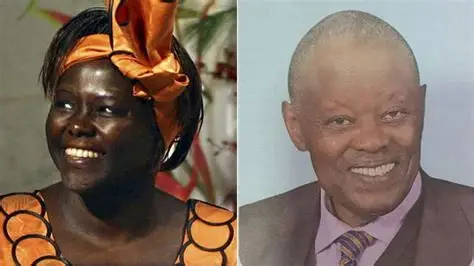


Before the Nobel Prize, before the Green Belt Movement, Kenya’s courts, press, and patriarchy conspired to destroy her. They failed.
She is remembered as the Nobel Laureate who planted trees and toppled tyrants — the indomitable Wangari Maathai, whose courage reshaped Kenya’s landscape, literally and politically.
But before the prizes and the praise, before the world knew her name, Wangari endured a different kind of battle: a very public, very deliberate campaign by a former husband, a compliant press, and a patriarchal judicial system to strip her of her name, her career, her children, and her dignity. They nearly succeeded.
A Meeting at the Mission Station
When Wangari returned from the United States in 1966, having completed her Master’s degree, she arrived into a newly independent Kenya hungry for educated professionals. Discrimination on grounds of gender and ethnicity had cost her one opportunity already, but she found her footing as a research assistant at Nairobi University’s Department of Veterinary Anatomy.
Around the same time, a young man named Mwangi Mathai was courting her. He too had studied in America and had a businessman’s eye — he had helped Wangari’s sisters establish a shop in Eastleigh. They got engaged. Then, in 1967, a German professor offered her a chance to continue her doctoral research abroad. She took it, spending a period she would later describe with great fondness — her last stretch of life as a free, unencumbered woman. Mwangi wrote anxious letters urging her to come home and start a family.
She returned in 1969. In two ceremonies that reflected the beautiful duality of their lives — a traditional ceremony at her father’s farm in Nakuru, and an elegant English-style wedding — she married Mwangi Mathai. She was reluctant to take his surname, knowing it was a European convention grafted onto African elite life, but she relented. She even registered all but one of her properties in his name. That single retained property would, years later, save her from homelessness.
Read also – The Woman Erased from Power: The Hidden Life of Lena Moi, Kenya’s Forgotten First Lady
The Political Wife
Mwangi soon set his sights on the Parliamentary seat for Langata. In those years, a politician’s home was also his campaign headquarters — a revolving door of supporters, strategists, and well-placed gossips, all of whom expected to find a properly “African” wife presiding over the household.
Wangari saw the paradox with crystalline clarity. These men had adopted European dress, European religion, European surnames — and then depended entirely on their wives to perform an Africanness they had otherwise discarded. She wrote of it candidly in her autobiography, Unbowed:
“I was very conscious of the fact that a highly educated woman like me ran the risk of making her husband lose votes if I was accused of not being enough of an African woman… They were often surprised that I spoke Kikuyu, as well as Kiswahili and English, and that they were received warmly by a woman they knew was a lecturer at the University.” — Wangari Maathai, Unbowed
She played the role with remarkable grace — adjusting her wardrobe, welcoming visitors personally, making every caller feel honoured. Many came expecting a remote, Westernised academic and left charmed. Despite her efforts, Mwangi narrowly lost the 1969 election, 3,030 votes to his opponent’s 3,591. That same period brought better news: she delivered safely at Nairobi Hospital, and soon after became the first woman in East and Central Africa to receive a Doctorate degree.
Envirocare – The First Green Dream
When Mwangi ran again and won the Langata seat, Wangari had campaigned alongside him with three children in tow, including a newborn. Victory, however, revealed a troubling side of her husband. He had promised jobs to thousands of unemployed constituents. When she asked what he intended to do about those promises, his reply was dismissive: “That was the campaign. Now we are in Parliament.” And when she pressed further, he said simply: “Don’t worry. They won’t remember.”
Wangari could not let it rest. She designed a project she called Envirocare — unemployed residents of Langata would tend the gardens and lawns of wealthier households for a fair wage. It was an early, instinctive blueprint for the community-based environmental work she would later develop into the globally celebrated Green Belt Movement.
The Seeds of the Green Belt Movement
Envirocare failed — the wealthy clients didn’t pay upfront, Wangari covered costs from her own pocket, and a drought killed the seedlings she’d sourced from Karura Forest. But the essential idea — that environmental restoration could also be a tool for community employment and dignity — would survive and flourish. The Green Belt Movement, born from this same instinct, eventually planted over 51 million trees across Africa.
Mwangi contributed nothing to Envirocare and did not believe in it. Its collapse became a silent “I told you so” in a marriage already cracking at its foundations.
The Divorce – Stripped Naked in Public
The marriage had been eroding for years, corroded by political differences — Wangari supported the parliamentary probe into the assassination of activist J.M. Kariuki, while Mwangi, as a government MP, sat on the opposing side. Then in 1977, she came home from the University one ordinary afternoon to find the house empty. He had packed up and gone.
In 1979, Mwangi filed for divorce. Rather than handle proceedings privately, he made them public — ensuring that everything would be dissected by the Kenyan press. Under the colonial-era divorce law still in force, grounds required cruelty, insanity, or adultery. Mwangi accused Wangari of adultery, and attributed his high blood pressure to her cruelty. The three-week case felt, she later wrote, like years.
Day after day, newspapers recounted the court details. The press reported that Mwangi sought divorce on grounds that she was “too educated, too strong, too successful, too stubborn, and too hard to control.”
Wangari later said she never heard those exact words from Mwangi directly and suspected the press had embellished freely — but the damage was done. She was being made a public example: a woman who had put her career above her husband’s comfort, and was now being punished for it.
She lost the case. Then came a further twist: a letter from Mwangi’s lawyer informing her she was no longer permitted to use his surname. The same man who had insisted she take his name now ordered her to relinquish it. In a small act of defiant creativity, she added a second ‘a’ to “Mathai.” She became Maathai. A name no one could take from her.
Contempt of Court – The Woman Who Refused to Apologise
A week after the ruling, she gave an interview to Salim Lone, editor of Viva magazine. She said what most people only whispered: that the evidence used against her was hearsay, and that the only way a judge could have upheld it was if he were incompetent and corrupt.
The judge was furious. Attorney General Charles Njonjo ordered her to retract and apologise immediately. Her response was characteristically unrepentant:
“It has been suggested that I should apologise even if I think I am right. In my school days they taught me that honesty is the best policy. I would be dishonest if I were to say that my divorce case was handled competently and honestly.”
— Wangari Maathai, 1979
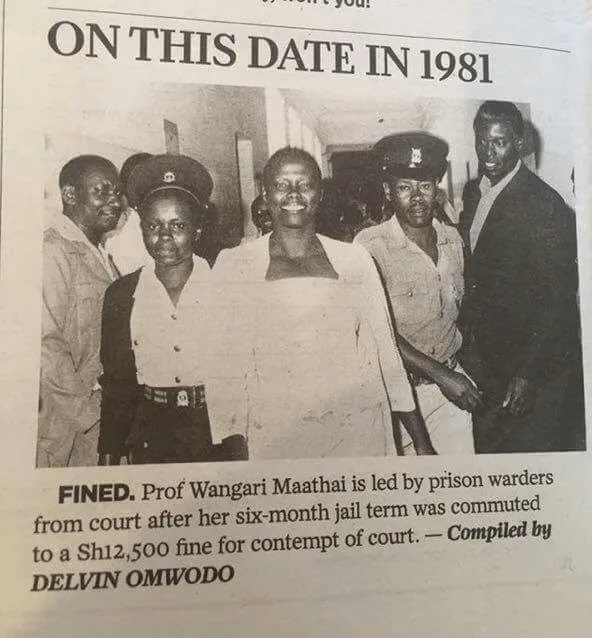
She was charged with contempt of court alongside Salim Lone. Lone was given a choice: six months in prison or a 40,000-shilling fine. Wangari was given no such option. She was arrested on the spot and taken to Lang’ata Women’s Prison, where her braids were cut off and she was put into uniform.
Three days in those conditions — her mind consumed with worry for her young children — before lawyers and friends applied enough pressure to secure her release. She walked out, famously, with a smile on her face.
Key Dates in Wangari Maathai’s Early Life
- 1966 – Returns from US with a Master’s degree; takes up research post at Nairobi University
- 1969 – Marries Mwangi Mathai in dual ceremonies. First child born. Narrowly loses Langata seat alongside her husband.
- 1971 – Becomes the first woman in East and Central Africa to receive a Doctorate degree
- 1974 – Envirocare collapses. Marriage deteriorates further over political differences.
- 1977 – Mwangi leaves without warning. Wangari founds the Green Belt Movement.
- 1979 – Divorce is finalised publicly. She is imprisoned for contempt of court — and walks out smiling. Adds an ‘a’ to her name: Maathai.
- 2004 –Awarded the Nobel Peace Prize — the first African woman to receive it.
- 2011 – Dies of ovarian cancer. Mwangi Mathai escorts her hearse — a final, quiet reconciliation.
The Tree That Would Not Fall
The divorce and its aftermath cost Wangari her job at the University of Nairobi and the home she had shared with her family. Since she had registered nearly all her properties under Mwangi’s name, she was left with almost nothing — almost. One small house in South C, held prudently in her own name, remained. She moved in and, from that modest base, built the Green Belt Movement into one of the most consequential environmental organisations in African history.
The patriarchal machinery that had tried to reduce her — the estranged husband, the compliant press, the biased courtroom, the Attorney General, the prison — had instead forged someone unbreakable. Every humiliation had been a test, and she had passed each one without once surrendering her essential self.
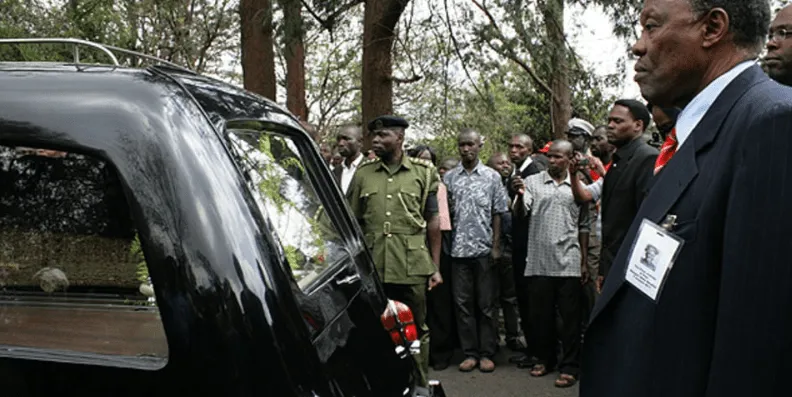
In 2004, the Nobel Committee awarded Wangari Maathai the Peace Prize — the first African woman to receive it. In 2011, she died of ovarian cancer. At her funeral, Mwangi Mathai, the man who had tried to erase her, escorted her hearse. It was, perhaps, his most honest acknowledgement of who she had always been.
“She added an extra letter to his name and made it her own — because her story would always be larger than the man who tried to end it.”
WANGARI MAATHAI · 1940–2011 · NOBEL LAUREATE